Asia’s legal industry is rapidly embracing AI, and its most significant transformation is being shaped by senior female practitioners committed to keeping technology ethical and human‑centric. From Microsoft to Bayer, women leaders across the region are redefining how AI is adopted, governed, and integrated into mentorship and career development.
Read the article in a curated PDF version for a more seamless reading experience.
Key highlights:
- Asia’s top legal practices and teams are moving from experimentation to structured AI adoption in 2026, embedding policies, training, and governance frameworks into their workflows.
- Legal teams at global organisations like Microsoft, Bayer, and Porsche are establishing responsible AI frameworks, shaping policies, training, and governance models that ensure technology is adopted safely, ethically, and with clear human oversight.
- Women legal professionals play a pivotal role in keeping AI human‑centric, stressing that technology must support rather than replace human judgment, empathy, and ethical decision‑making.
- Mentorship is evolving in the age of AI, with senior lawyers guiding juniors to develop strategic thinking, creativity, and professional judgment.
AI adoption picks up pace at Asia’s top law firms and in‑house teams
Artificial intelligence (AI) is no longer a distant concept in Asia’s legal industry. It is now firmly entrenched in major legal practices, from contract review and legal research to case advice and strategy. For many legal professionals, AI has become a daily reality, reshaping how professional legal services are delivered and risks are managed.
The 2026 AI in Professional Services Report shows that adoption has surged: 40% of organisations now use generative AI, nearly double the rate from 2025. Among professionals already using these tools, more than 80% report weekly use, with over half relying on them daily. The report also found that 87% expect AI to be central to their workflow within five years.
Building Responsible AI Policies and Governance Frameworks
At Cyril Amarchand Mangaldas (CAM), the shift has been deliberate. “We introduced an internal AI policy that sets out principles for responsible and secure use of AI”, says Komal Gupta, CAM’s Chief Innovation Officer.
The Indian law firm also simultaneously launched a company‑wide AI learning series and a network of ‘AI Innovation Champions’. The result? An over 80% adoption rate across the business. But more importantly, the interventions have resulted in a cultural shift, with employees beginning to view AI as “an integral part” of delivering more efficient, thoughtful, and value‑driven services, Gupta explains.
“Safe and efficient AI adoption requires an effective AI governance framework to achieve a delicate balance between business values and risks mitigation.”
– Goh Sin‑Ying, Head of Legal and Compliance, Porsche Asia Pacific

In‑house counsel are equally pivotal in the growing use of AI legal tools and solutions. Goh Sin‑Ying, Head of Legal and Compliance at Porsche Asia Pacific, describes it as playing “the role of an AI governance architect”, in which she acts as “the bridge between innovation, business KPIs, integrity and risks”.
“Safe and efficient AI adoption requires an effective AI governance framework to achieve a delicate balance between business values and risks mitigation,” Goh adds.
How women legal professionals keep AI human-centric
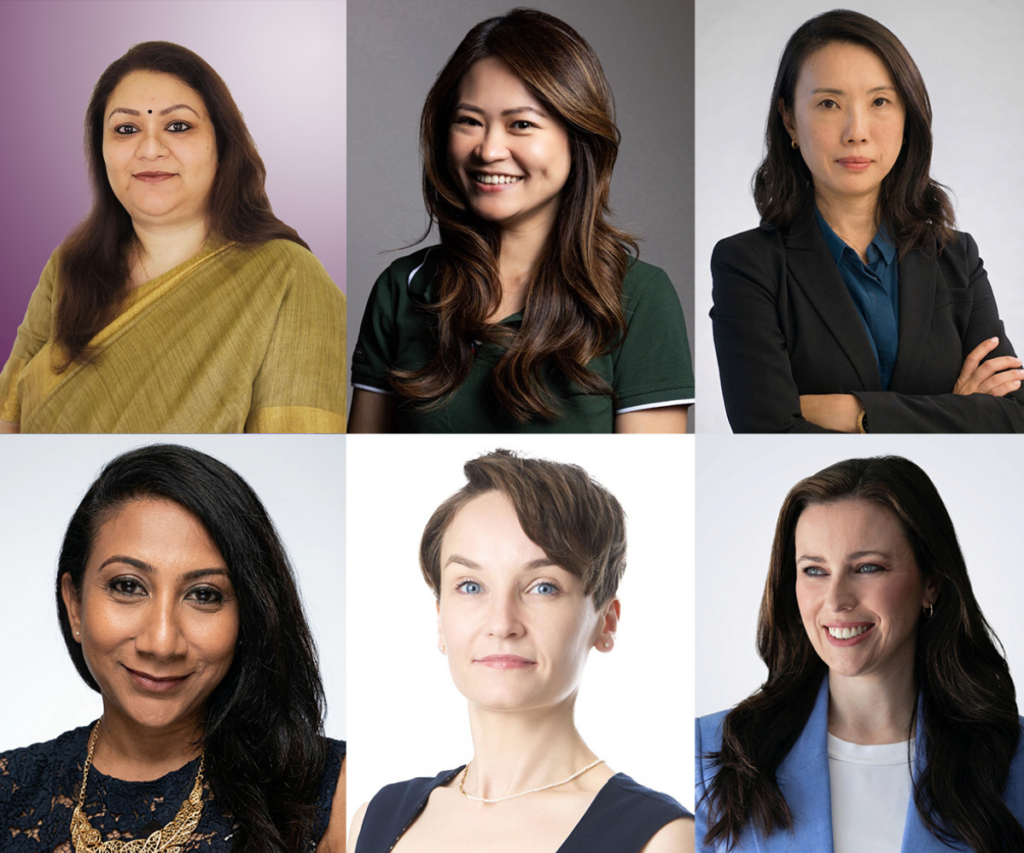
As AI becomes more deeply embedded in legal practice, the question is no longer about whether to adopt it, but about how to ensure it remains human‑centric. And female team leads at Microsoft Asia, Bayer Southeast Asia, and CMS Hong Kong are at the centre of this conversation. They emphasised that technology must serve people, not replace them. Their perspectives highlight the importance of ethics, mentorship, and trust in keeping innovation grounded in human judgment.
Earlier perspectives on how leading women lawyers are driving innovation in Asia highlight the leadership foundations now shaping responsible AI adoption.

“In an AI-driven world that increasingly rewards speed and scale, our presence affirms something deeper — that the law ultimately exists to serve people, and people cannot be reduced to data points.”
– Carol Lee, Asia Proactive Risk Mitigation Senior Corporate Counsel, Microsoft
“In an AI-driven world that increasingly rewards speed and scale, our presence affirms something deeper – that the law ultimately exists to serve people, and people cannot be reduced to data points,” says Carol Lee, Asia Proactive Risk Mitigation Senior Corporate Counsel, Microsoft.
While AI can draft, summarise, and predict patterns more efficiently than humans, it “cannot carry the weight of an anxiety-fueled sleepless night or the moral clarity required when the ‘efficient’ answer is not the just one’, Lee adds.
This sentiment is one that Tyrilly Csillag, Product Strategy Director for Practical Law across APAC, the Middle East, and Africa at Thomson Reuters, knows well. As a solicitor and legal tech advocate, she has spent years thinking about what it truly means to keep AI grounded in human expertise – not just as a design philosophy, but as a product reality.
“Human in the loop is the foundation of everything Practical Law is built on, because our content is written and maintained by our 700+ in-house human legal experts globally. This unique team, together with our external contributors, brings real-world experience, contextual awareness, and professional judgment to our content, which is something no AI model can replicate on its own,” says Csillag.
“When we combine CoCounsel and add AI-enabled Deep Research to Practical Law, we are multiplying the force of that combined human experience for today’s lawyers, not replacing it,” she adds.
“Human in the loop is the foundation of everything Practical Law is built on, because our content is written and maintained by our 700+ in-house human legal experts globally…Combining with AI-enabled Deep Research, we are multiplying the force of that combined human experience for today’s lawyers.”
– Tyrilly Csillag, Product Strategy Director for Practical Law across APAC

“Human Judgment Remains Essential”: Senior Women Lawyers

“My motivation has always been simple: protect people, improve their work lives, and let them focus on the work that truly matters.”
– Mel Nirmala, ASEAN Legal Ops Excellence Lead, Bayer Southeast Asia
At German pharmaceutical company Bayer’s Southeast Asia offices, it was ASEAN Legal Ops Excellence Lead, Mel Nirmala, who spearheaded the regional development of LEX, an in-house agentic AI navigation platform. Under her supervision, LEX evolved into a company-wide solution that helped to reduce employees’ workload by more than 2,500 hours.
For Nirmala, the motivation has always been “to protect people, improve their work lives, and let them focus on the work that truly matters”. She cautions that while AI can accelerate tasks, it has “no emotion, intuition, or contextual awareness.”
“As humans, we read the room, adjust our messaging, and make decisions shaped by experience. My brain can instantly recall what to include or exclude based on history and nuance — AI cannot. It still requires close monitoring, because it will simply generate outputs without understanding consequences,” Nirmala adds.
Maren Wibke Weigl, Senior Associate at CMS Hong Kong and a member of the firm’s international AI, technology, and innovation working groups, stresses that “human judgment remains essential” as the “core” of legal work lies not in the “production of text”, but in the “act of deciding”.
Drawing on her background in dispute resolution, she notes that while most large language models can produce outcomes that feel “persuasively responsive”, what reads as confidence is ultimately linguistic probability: “They cannot assess individual risk appetite or consider unique consequences, and can therefore fail to recognise when a seemingly small factual detail alters the legal strategy entirely.”
At Microsoft, the human advantage is not just a slogan. “It is our daily work”, says Lee.
The evolution of mentorship and career pathways in 2026
Nevertheless, with AI slowly but surely automating many of the routine tasks that once defined junior roles, young legal professionals now risk becoming mere “AI operators” rather than strategic advisors. It is thus more crucial than ever that senior legal professionals play their part in preventing such an outcome.
“Reallocating supporting work to AI creates space for mentoring that develops professional intuition early and preserves the integrity of legal advice as workflows evolve.”
– Maren Wibke Weigl, Senior Associate, CMS Hong Kong

For now, that scenario thankfully seems like a vague possibility, with mentorship programmes evolving to meet the industry’s needs. Senior leaders like Gupta, Lee, Nirmala, Weigl, and Goh share how they have each taken on the highly important role of mentoring younger colleagues to think critically about professional AI usage.
Reflecting on her own training, Weigl notes: “As a junior, I often wished I could spend more time discussing case strategy with senior colleagues, rather than having most of that time taken up by preparing summaries, timelines, and overviews.”
AI tools can streamline such supporting work and reallocate time to the aspects of legal practice that clients ultimately expect their lawyers to take responsibility for. In her view, this also allows senior lawyers to focus their mentoring on developing professional intuition among younger colleagues, helping to maintain the integrity of legal advice even as workflows change.
For Gupta, mentorship in the age of AI is ultimately about helping young professionals understand how technology will reshape law practice, as well as how creativity, judgment, and curiosity will remain their greatest strengths.
The future of legal practice in Asia
With Asia’s legal industry fast evolving into AI‑first organisations, senior legal professionals will also continue to play a key role in ensuring that the focus of AI adoption and usage will be on how professionals deliver advice, strategy, and client trust.

“AI is a powerful tool for augmenting legal work, but the practice of law ultimately rests on judgment, accountability, and trust – qualities that cannot be automated.”
– Komal Gupta, Chief Innovation Officer, Cyril Amarchand Mangaldas
In response to this AI-first evolution, Thomson Reuters’ Csillag confirms the need for lawyers to build legal understanding, not just an ability to find answers. “In an AI-first world, the distinction between developing lived, practical legal knowledge and an ability to find fast answers matters more than ever, because the lawyers who thrive will be those who know how to think, not just what to search”, says Csillag.
Innovation teams will continue to accelerate adoption, with women’s leadership central to the shaping of both technical and cultural boundaries. Porsche’s Goh sees herself “becoming (a) subject matter expert in the laws and regulations related to AI technology, data privacy and cyber security”, in order to help improve the AI governance framework.
On the contrary, Microsoft’s Carol Lee prefers taking a more balanced approach, one where technology intersects with humanity. “I want to believe the future belongs to those of us who can combine capability with character. I will keep learning the tools, using AI to ask the hard questions about ethics and create better policies with impact instead of penalty,” she says.
“Most importantly, it is showing up for the people who place their trust in us as women and legal professionals.”
Read the article in a curated PDF version for a more seamless reading experience.
_______________________________________________________________________________________
Strengthen your team’s ability to navigate AI‑driven legal work with confidence.
Explore Practical Law Asia’s expert insights and practical tools that help you navigate an evolving legal landscape with confidence.
Fill in the form to request access Practical Law Asia’s AI Toolkit and see how leading in-house teams are combining human expertise with AI to move faster, with greater certainty.