Every lawyer has seen it. An AI output that reads with complete authority, and turns out to be wrong only after someone has signed off.
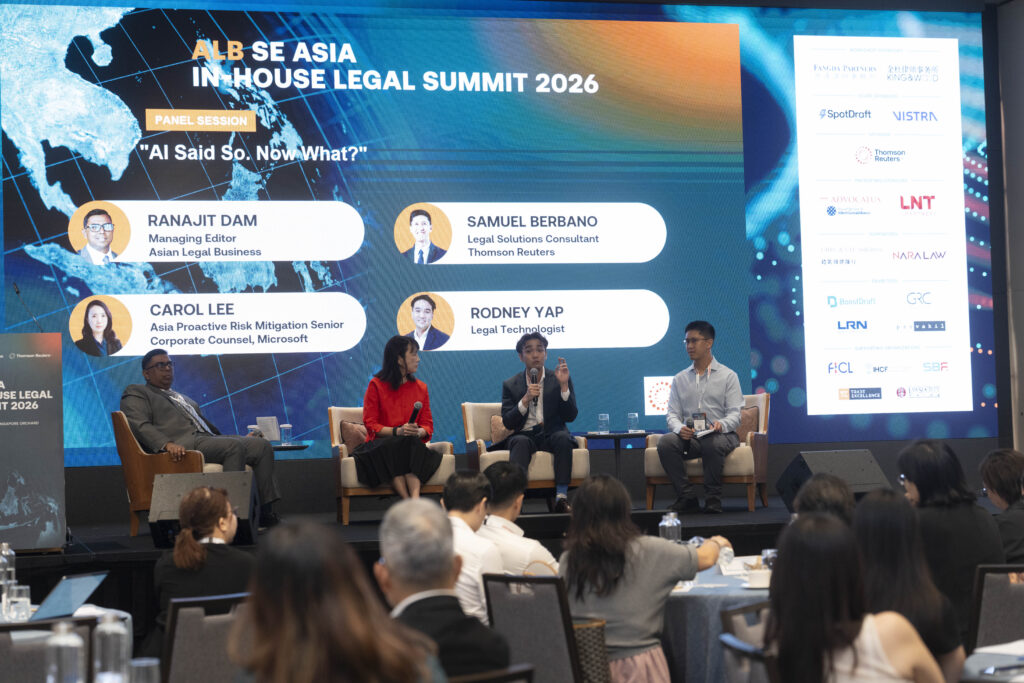
That question puts source verifiability at the centre of “AI Said So. Now What?”, a panel at the ALB Southeast Asia In-House Legal Summit (20 May, Hilton Singapore Orchard), moderated by Ranajit Dam, Managing Editor of Asian Legal Business, with Carol Lee (Senior Corporate Counsel, Asia Proactive Risk Mitigation, Microsoft), Samuel Berbano (Legal Solutions Consultant, Thomson Reuters), and Rodney Yap (Legal Technologist).
The verification problem
The session started with a topic that many in-house teams are working through without a playbook. AI tools produce authoritative-sounding legal output with no citations or ways to retrace the reasoning. It means AI output is wrong in ways that look entirely right. For the lawyer who signs off, that unverified output carries real liability.
Carol Lee, who has spent 20 years at Microsoft moving through hardware, software, cloud, and now AI, grounded the issue in her own observations. The ability to verify AI output depends entirely on having the underlying legal knowledge to recognise when something is off. She drew a parallel to Singapore’s approach to primary school mathematics, where mental arithmetic comes before the calculator. The tool is introduced after the foundation is built. Her point for legal practice follows the same logic. Contract fundamentals, warranty structures, arbitration clauses, and force majeure have not changed because AI has arrived. What has changed is the pressure on lawyers to interrogate AI’s interpretation, often without the experience to do so confidently.
“AI output is wrong in ways that look entirely right. For the lawyer who signs off, that unverified output carries real liability.” — Ranajit Dam, Managing Editor, Asian Legal Business, Thomson Reuters
Samuel Berbano, whose background is in appellate law, raised a related concern about framing. In appellate practice, how an issue is framed determines the outcome. When a lawyer accepts an AI-generated answer without examining how the AI defined the underlying question, they have conceded the framing of the question without realising it. Grounding AI output in trusted, citable sources is how lawyers retain control over the analytical framing. A pinpoint citation that links directly to the source paragraph makes the reasoning interrogable.
“When a lawyer accepts an AI-generated answer without examining how the AI defined the underlying question, they have conceded the framing without realising it.” — Samuel Berbano, Legal Solutions Consultant, Thomson Reuters

The hidden cost of supervision
Verification is only part of the problem. The other part is the cost of verifying, which most in-house teams are absorbing without accounting for it.
Legal teams are now supervising both their junior lawyers and the AI that those lawyers rely on. That means knowing which platforms are in use, what data is being uploaded, and what the privacy and compliance implications are. This is a layer of oversight that did not exist three years ago. At the same time, the business expects AI to speed up legal work. The efficiency gains are assumed, but the supervision costs are not counted. And that gap is where errors occur and where legal teams absorb risk without adequate resources.
Lee added that responsible AI use is a question of trust as much as it is of technology. In-house counsel carry accountability for how AI is deployed inside their organisations, and that accountability does not transfer to the tool.
“Accountability does not transfer to the tool.” — Carol Lee, Senior Corporate Counsel, Microsoft

Managing AI output when time is short
Rodney Yap focused on the practical challenge of reviewing AI output efficiently when time is short. His view is that not all AI output carries the same risk, and uniform scrutiny is neither practical nor necessary. The task is to know where to look. Use the AI itself to flag where its own output is most likely to be unreliable, then concentrate human attention there.
He outlined three techniques. First, after receiving an AI-generated answer, start a fresh session, tell the AI it is wrong, and provide a false correction. A model that immediately agrees should not be trusted; a model that holds its position and explains why is more reliable. Second, run a separate AI session to challenge the first output. Ask it to approach the answer the way a counterparty would. This stress test will not replace a careful read, but it tells you where to concentrate in your review. Third, treat any claim without a pinpoint citation as your highest review priority. A cited claim can be verified directly. Unsupported assertions require real scrutiny.
The principle, as Yap puts it, is to concentrate human effort where the AI has given you no basis for confidence.
“Concentrate human effort where the AI has given you no basis for confidence.” — Rodney Yap, Legal Technologist

What happens to judgment when AI does the generating work
The panel turned next to the question that matters most for legal teams. How does the profession build capability over the next few years?
Berbano argued that junior lawyers have traditionally built professional judgment by doing the generating work, including drafting, researching, and constructing arguments. That process is how a lawyer develops a sense of what is wrong in a clause, or where an argument is thin. AI has taken over much of that work. The junior’s role has shifted to reviewing and checking output. Despite that compressed development runway, the profession has yet to work out what to replace it with. He suggested making training more deliberate. One way is to give junior lawyers multiple AI-generated answers to the same legal problem, only one of which is correct, and ask them to identify the correct one and explain why. It builds the critical filter that years of drafting experience would otherwise develop on its own.
Lee shifted the focus. Her concern was less about what junior lawyers are producing and more about what they are no longer being asked to do. Reading the room in a negotiation, a regulatory conversation, or an internal investigation, the work of assessing whether someone is telling the truth is judgment built through human experience, not through reviewing AI output.
Another unique human edge is the voice. Every lawyer develops a voice through years of drafting, advising, and being tested on their analysis. Voice is the accumulated character of how a lawyer thinks, persuades, and stands behind their arguments. The voice that makes a piece of advice recognisably theirs, and trusted because of it, does not emerge from editing AI-generated text. It has to be built through doing the work. In-house teams focusing on simple AI efficiency metrics should start asking whether their lawyers are still developing the voice and judgment they will need five years from now.
“The voice that makes a piece of advice recognisably theirs, and trusted because of it, does not emerge from editing AI-generated text. It has to be built through doing the work.” — Carol Lee, Senior Corporate Counsel, Microsoft
Yap took a different angle. His view was that judgment in an AI-assisted environment comes from learning how the tool fails, not just how it succeeds. Lawyers who understand their tools’ failure modes catch errors earlier and ask sharper questions. Without this tool literacy, you cannot tell which teams have built real capability and which have only sped up.
“Without tool literacy, you cannot tell which teams have built real capability and which have only sped up.” — Rodney Yap, Legal Technologist

The AI standard that matters
Dam closed the session by asking each panelist for one concrete action an in-house team can take to ensure adoption builds rather than erodes legal capability.
Yap’s answer was to stop chasing the newest model and start getting to know the one you use. Frontier models now perform at comparable levels. What separates effective use is depth of familiarity. That knowledge is what lets a team integrate AI into a workflow intelligently.
Lee’s answer was to go back to the source document every time, regardless of how complete the AI output appears. The professional habit of checking rather than accepting is what keeps lawyers on the right side of the reliability line.
Berbano’s answer was to measure outcomes, specifically time saved, risk contained, and budget sustained. Without measurement, there is no way to distinguish teams that are more capable from teams that are moving faster.
Continue the Conversation at Synergy Singapore
Want to continue the conversation? Join us at the Synergy Singapore on 16 July, where legal professionals come together to explore the evolving intersection of AI, governance, and in-house legal practice. Connect, collaborate, and keep the dialogue going beyond the summit. Register here.